Internet Time
When Swatch Invented A New System of Timekeeping
Words: Georgia Griffiths
Last week I was contemplating why we adhere to traditional structures of time - seconds, minutes, and hours - based around segments of 60. Totally normal late-night musings, I promise you. Sixty has always felt like a strange choice to me, as someone who has grown up with a metric system where so many other things are constructed around multiples of ten.“But the imperial system is based around the number 12!” I hear you say. This only applies to length (i.e. 12 inches = 1 foot), not weight (base-14 or base-16) or volume (base-20, or inexplicably base-8).
Yet the world continues to persist with Coordinated Universal Time (UTC), a time-measurement system based around the number 60. But in my contemplative Google-searching last week, I discovered another option: Swatch Internet Time.
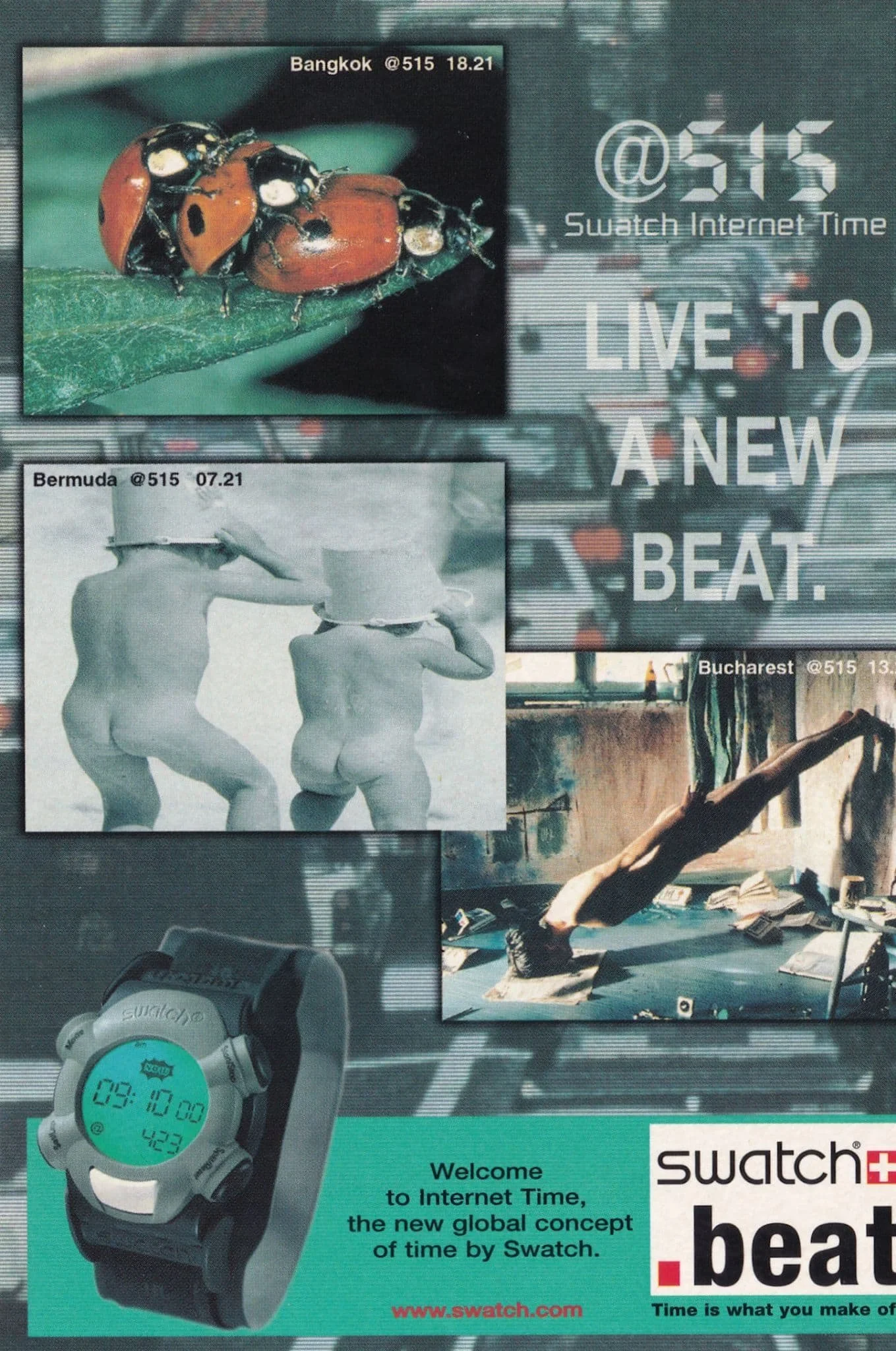
A Swatch .beat watch advertisement.
Introduced in October 1998 by Swatch as a marketing tool for their .beat watch, it proposes a new system for time-measurement across the globe. It’s not an entirely new concept - Swatch Internet Time is derived from the decimal time system, which the French Revolutionaries had a good go at in the 1790s, before Napoleon did away with it twelve years later.
Instead of hours and minutes, a day is divided into 1000 parts, which Swatch called ‘.beats’. A .beat is 86.4 seconds, and an hour lasts for approximately 42 .beats. The location for time’s beginning (i.e the equivalent to UTC’s Greenwich), is Biel/Bienne, the Swiss town in which Swatch’s headquarters is located. The universal reference for Swatch Internet Time is BMT - Biel Meantime. Midday BMT is @500 Swatch .beats.
In Swatch Internet Time, there is no AM or PM, no daylight savings, and no time zones. It’s a beautiful piece of pre-2000s internet optimism. The entire world exists on the same time, meaning the .beat time in Sydney is the same as the .beat time in London. Swatch puts this notion in quite a charming way: “For example, if a New York web-supporter makes a date for a chat with a cyber friend in Rome, they can simply agree to meet at an @ time" - because internet time is the same all over the world.” There would be no time-based jetlag, as circadian rhythms would align to the sun rather than the man-made clock (although unfortunately air travel fatigue would still remain). MIT Media Lab director Nicholas Negroponte, who helped Swatch inaugurate the new system in 1998, argued that “this is just the beginning…it’s the beginning of understanding that cyberspace has no boundaries, no limits, no geography, no distance.”

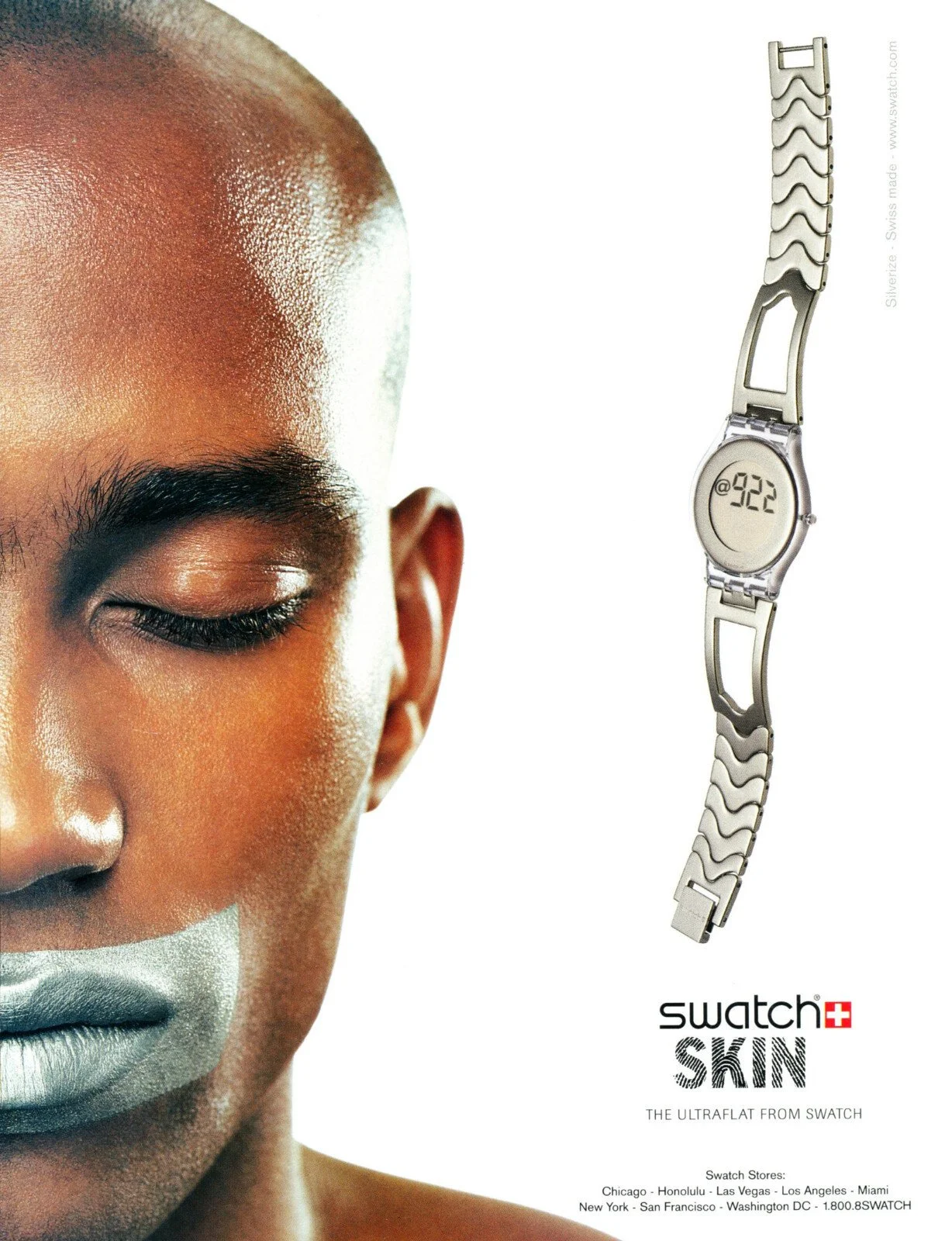
Swatch .beat watch advertisements.
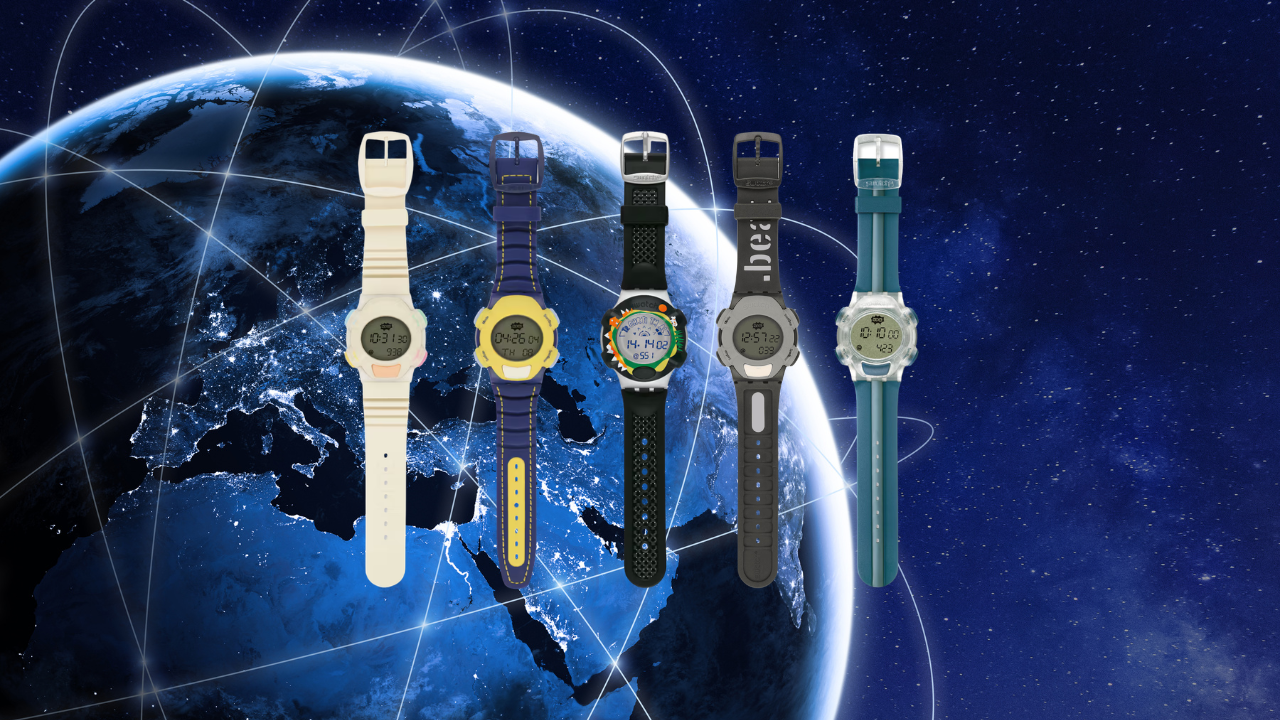
To display their new system Swatch created a number of .beat watches - digital watches that displayed both conventional time with the .beat time beneath it. These were big plastic, biomorphic shapes emblematic of Y2K design, available in a wide range of colours.
There were also some early third-party adopters of the new system. In the early 2000s, the CNN International website hosted an Internet Time converter alongside its traditional UTC world time converter, referring to Internet Time as “a completely new global concept of time”. Ericsson released a mobile phone, the T20e, which could display Internet Time, and the video game Phantasy Star Online adopted it as a way for international users to play online together. Swatch even ran their internal meetings on .beat time. It’s a clever bit of marketing from Swatch, and a genuinely interesting idea.
Perhaps understandably, Swatch Internet Time never overtook UTC as the primary method of timekeeping. As Swatch’s Carlo Giordanetti, now CEO of the Swatch Art Peace Hotel, told NPR in 2014, the best reception to Swatch Internet Time was found in Japan. The hypothesis is that this was due to the cute design of the .beat watches, which often had a little cartoon dog ‘living’ in the digital display. But once other ideas came to the fore, says Giordanetti, Swatch began to use Internet Time less, and it soon fell away. However, they do still display it on the top left corner of the official Swatch website.
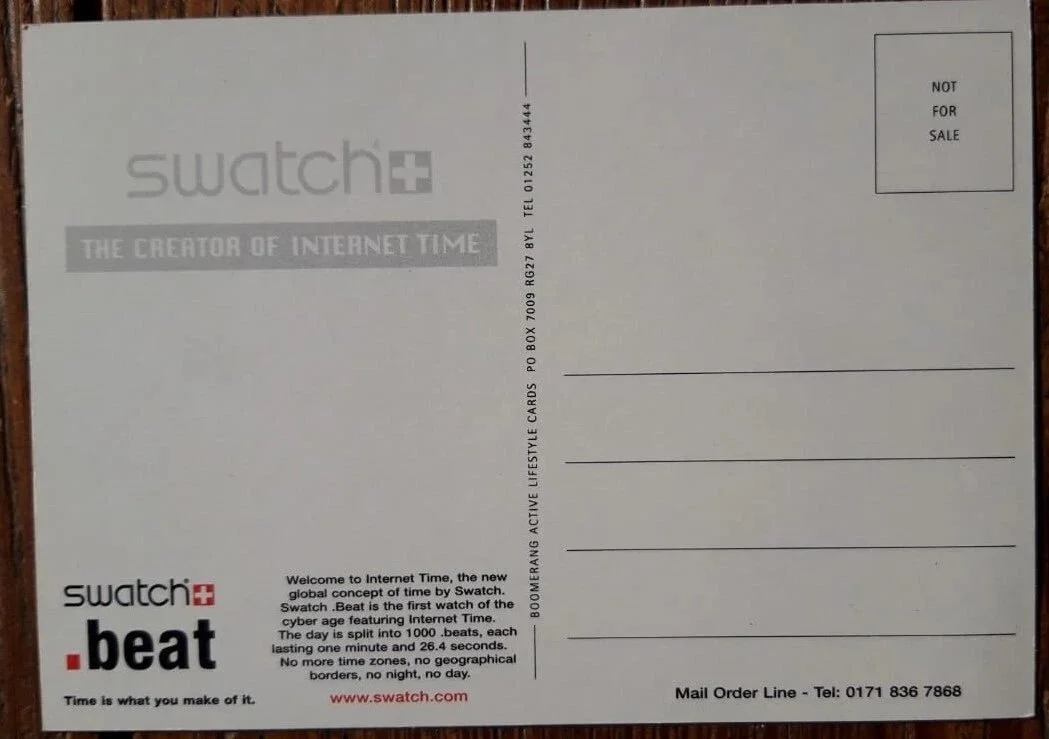
A Swatch .beat promotional postcard.
While we may still be beholden to the traditional notions of time that come with the UTC system, it is heartening to know that there is an alternative, should we as a society choose to do something different in the future. I’ve taken to checking the Internet Time a few times a day, to see if I can eventually figure out the conversion from UTC to .beats in my head. Just don’t be alarmed if I start asking you to meet for coffee at @250 before work.
You may also like
-
![]()
This Lotus Elise Is A Fully-Functional Mobile Coffee Shop
Cars and coffee collide in a new way at Café Elise.
-
![]()
An Oasis In The Heart Of The City: The Barbican Conservatory
Tropical Brutalism never looked so magical.
-
![]()
Coveted Object: Omega Constellation Manhattan
While all Omega Constellations are created equally, some are more equal than others.
-
![]()
Going Big, Bold and Bright with the Doxa Sub 300T Divingstar
Unapologetic in its purpose, the Doxa Sub 300T brings an authenticity rarely seen from other watches.
-
![]()
The Rolex Oyster Perpetual Pistachio could be the perfect everyday watch
This green doesn’t shout, it whispers.
-
![]()
A House Amongst The Trees: The Lobster Bay House
A beautiful reminder of the magic that great architecture has.
-
![]()
Coveted Object: Arno Coffee Cups
“If you’re going to have an apple, make sure it’s the crunchiest, juiciest apple you can find.”
-
![]()
Scorpio By Name & Nature: The Abarth 695 Competizione
A jellybean-shaped muscle car that oozes charisma.